
VIN-Based Operations
VIN-Based Operations
- VIN-based order intake and planning
- Vehicle model, load class and billing category logic
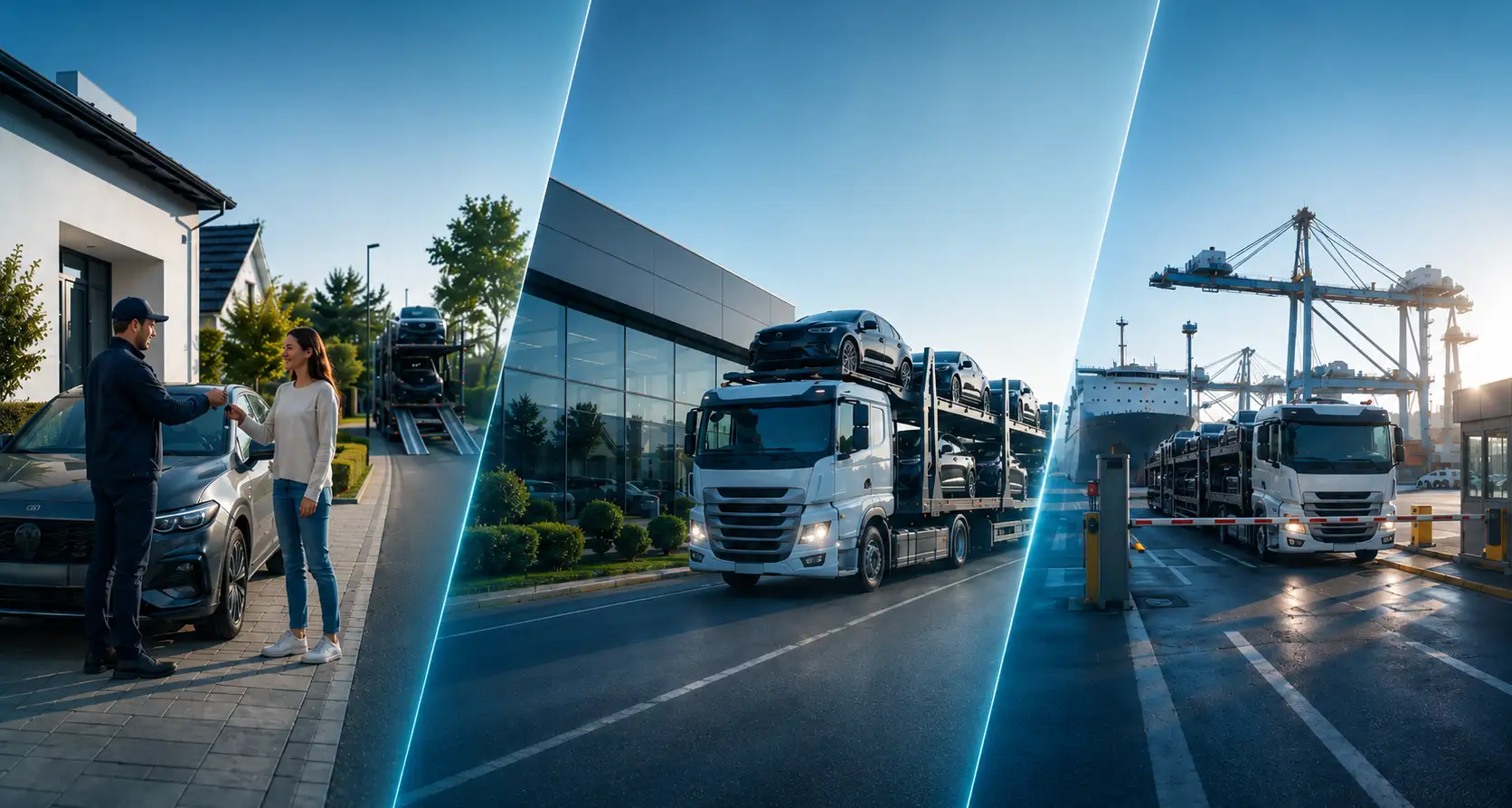
// Automotive Car Carrier TMS
Finished vehicle logistics is not general cargo. This page explains the daily operational realities of car haulers - from VIN-based orders and multi-vehicle dispatch to damage statuses, driver execution, documents and billing proof - and why they require a dedicated Automotive Car Carrier TMS.
Car haulers do not simply move freight from A to B. They manage VINs, multi-vehicle loads, compounds, release statuses, hold statuses, damage information, customer-specific contracts, delivery windows, special handling requirements, driver execution, proof documents and billing rules that often differ from customer to customer.
Generic Transport Management Systems can support parts of that process. But in many finished vehicle logistics operations, large parts of the work happen around the system: in Excel files, emails, phone calls, manually updated status lists, custom-built tools and dispatcher know-how.
LogiSense by EONIQ is built for the reality of automotive logistics. It is an AI-native Automotive Car Carrier TMS platform for finished vehicle logistics carriers - designed around the specific workflows of car haulers, not adapted from general cargo after the fact.
Also referred to as a Car Hauler TMS, Car Carrier TMS, FVL TMS or Finished Vehicle Logistics TMS, this category of software must support workflows that generic freight systems were never designed for.
For the broader category landscape beyond carrier transport management, read our expert guide to Finished Vehicle Logistics Software.
// Category definition
Most transport management systems were designed for general freight. They manage shipments, pallets, containers, parcels or standard loads. That works well for many transport operations - but finished vehicle logistics is different. Finished vehicle logistics is built around vehicles. That difference changes almost everything.
These are not edge cases in finished vehicle logistics. They are daily operational reality.
When a generic TMS does not model these realities properly, teams often compensate manually. Dispatchers maintain additional spreadsheets. Customer service teams search through emails. Billing teams collect documents manually. IT teams build workarounds. Management loses visibility into the real operational situation.
The problem is not that generic TMS platforms are bad. They are often very good at general freight. The problem is that finished vehicle logistics is a specialist domain.
// Built for FVL carriers
LogiSense is designed for carriers that move finished vehicles by truck — from order intake to dispatch, driver execution, document handling and billing preparation. The system is built around the specific questions car hauler operations deal with every day:
A specialist FVL TMS needs to make these questions visible and manageable — without forcing users to translate everything into generic freight workflows.
Multi-VIN load building connects orders, vehicle status, dispatch, driver execution and proof documents.
01
// EXTRACT
02
// RELEASE
03
// OPTIMIZE
04
// EXECUTE
05
// INVOICE
Finished vehicle logistics complexity often starts before the first transport order is even created. Every customer can bring different interfaces, order formats, contract structures, price matrices, document requirements, delivery processes, damage code expectations and billing rules. For many carriers, onboarding a new customer is therefore not only a commercial task. It is also a system configuration and integration challenge. LogiSense is designed to support this full operational chain.
01
Customer onboarding can include interfaces, order formats, price matrices, document templates, delivery proof requirements and workflow differences. LogiSense supports flexible workflows and configuration approaches that help incorporate customer-specific requirements faster and without long development cycles.
This includes integrations with customers, OEMs, compounds, surrounding business systems and telematics platforms where required. Our template engine makes it easy to configure invoices, documents, checklists, numbering schemes and much more. The agreed service components of an order can be configured with our workflow engine, so that services beyond transport, email sending and other operational steps can also be configured.
02
Transport orders enter the system through different channels, either manually or via interfaces, and in different formats. LogiSense supports structured order entry with generated transformation scripts and AI-supported order recognition.
For example, a user can copy and paste a transport order email into the system or connect their Outlook account. The AI then identifies the relevant data, such as customer, contract, service, VIN and other order details. The user reviews the result and can create the transport order with one click.
This reduces manual entry while keeping the user in control.
03
Finished vehicle logistics billing often depends on more than a simple rate per kilometre or shipment. Contracts may include price matrices by model, load class, billing category, service type, route, surcharge logic or customer-specific conditions.
LogiSense is designed to reflect this contract and service logic as part of the operational workflow, so that order intake, dispatch, documentation and billing preparation are connected.
04
In finished vehicle logistics, transport planning depends on the status of every single vehicle. A vehicle may be physically available but not yet released, for example because it is financially blocked, has commercially unacceptable damage or requires repair. It may also have a target delivery date or a special delivery process.
LogiSense creates VIN-based visibility and informs planners about all vehicle statuses that are relevant for load building and execution.
05
Car hauler dispatch is not the same as assigning a generic shipment to a truck. Dispatchers need to combine multiple VINs into feasible and efficient loads while considering truck capacity, routes, pickup and delivery sequences, driver availability, customer priorities and vehicle-specific restrictions.
LogiSense supports the dispatch process and can integrate proven load-building optimization, such as INFORM’s LoadBuilder AI, to help improve truck utilization and routing — especially in larger fleets where manual optimization becomes increasingly difficult.
06
Execution depends on clear communication between dispatchers, drivers, compounds, customers and sometimes end customers.
LogiSense supports driver execution through its own Driver App and can additionally interface with common on-board unit and telematics systems such as WebFleet, Spedion, Fleetboard and similar platforms.
This allows carriers to combine structured finished vehicle logistics workflows with existing fleet communication infrastructure.
07
Finished vehicle logistics requires more detailed status and exception handling than many standard freight workflows.
Drivers must be able to capture damage information in the app, and that information may need to be translated into OEM-specific codes. Ad-hoc hold changes from the OEM also need to be processed as quickly as possible and considered in planning and execution.
The way damage is handled, and how well pre-existing damage is documented, can make a significant financial difference. In the damage claim process, the responsible parties for a damage event are identified across the parties involved, and the corresponding invoices or compensation payments are triggered and tracked.
Additional requirements may also apply, for example for high & heavy vehicles, used vehicles, special delivery processes to end customers or handover documentation.
LogiSense makes these specialist requirements part of the workflow instead of leaving them in notes, emails or spreadsheets.
08
Documents play a central role in finished vehicle logistics: delivery proof, damage documentation, customer forms, handover records and invoice attachments.
LogiSense supports document handling and AI-assisted extraction of relevant fields from imported documents. This turns unstructured information into usable operational data quickly and efficiently. The template engine makes it easy to set up customer-specific document templates.
09
Customer service teams often need to answer questions such as:
For these and many other questions, the LogiSense AI Assistant helps find answers, trigger operational actions and draft replies to customer emails - directly using real data from the system, such as available VIN, status and order data.
This is where AI becomes practical: not as a separate chatbot, but as support directly inside the transport workflow, for internal planners, dispatchers and service teams, and also directly in the customer portal.
10
In finished vehicle logistics, billing is not only about calculating a price. It often depends on providing the right delivery proof, damage documentation, customer-specific attachments, handover documents or other supporting records.
Different customers may require different documents before an invoice can be accepted.
LogiSense connects operational execution, document handling and contract logic to support billing preparation with customer-specific proof requirements.
The difference between a general cargo TMS and a specialist finished vehicle logistics TMS is not only terminology. It is a different operating model.
| General Cargo TMS | Automotive Car Carrier / FVL TMS | |
|---|---|---|
| Operating focus | Shipment/load | VIN/status |
| OEM/customer-specific FVL workflows | Limited | ✓ |
| Multi-VIN car carrier dispatch | × | ✓ |
| Delivery proof, damage documents and customer-specific attachments | Basic | ✓ |
| Contracts, model/load classes, billing categories and surcharges | Limited | ✓ |
| VIN, load, release, damage, hold and delivery status | × | ✓ |
| OEM, customer, compound, telematics and document-driven workflows | Generic | ✓ |
Operating focus
General Cargo TMS
Shipment/load
Automotive Car Carrier / FVL TMS
VIN/status
OEM/customer-specific FVL workflows
General Cargo TMS
Limited
Automotive Car Carrier / FVL TMS
✓
Multi-VIN car carrier dispatch
General Cargo TMS
×
Automotive Car Carrier / FVL TMS
✓
Delivery proof, damage documents and customer-specific attachments
General Cargo TMS
Basic
Automotive Car Carrier / FVL TMS
✓
Contracts, model/load classes, billing categories and surcharges
General Cargo TMS
Limited
Automotive Car Carrier / FVL TMS
✓
VIN, load, release, damage, hold and delivery status
General Cargo TMS
×
Automotive Car Carrier / FVL TMS
✓
OEM, customer, compound, telematics and document-driven workflows
General Cargo TMS
Generic
Automotive Car Carrier / FVL TMS
✓
// Build vs. buy
Because finished vehicle logistics is so specific, many logistics service providers and automotive carriers have not chosen a generic TMS. Instead, they invested in bespoke software — either by building their own development and operations teams or by asking software companies to create custom-made systems around their individual processes. That decision was often understandable. Generic systems did not reflect the complexity of VIN-based workflows, customer-specific contracts, multi-vehicle dispatch, damage handling, delivery documentation and billing requirements. With LogiSense, there is now a third option: a specialist platform built for finished vehicle logistics, with the flexibility to reflect customer-specific processes and ongoing change.
01
Useful for general freight, but often limited when it comes to finished vehicle logistics workflows, VIN-based processes, customer-specific documentation and FVL billing logic (see above).
02
Can reflect individual business processes precisely, but usually requires significant internal effort, long implementation cycles, operational dependency and higher project risk.
03
Built specifically for finished vehicle logistics and designed as a flexible platform that can adapt to customer-specific requirements, operational change and AI-native workflows.
// First AI-Native TMS for FVL
AI in transport management should not be a gimmick. It should help users work faster, make better decisions and reduce repetitive manual effort.
LogiSense is designed as an AI-native system. That means AI is not simply added as a feature on top of an old architecture. It is part of the way the platform uses data, knowledge, workflows and user interaction.
At the foundation, LogiSense combines structured operational data with unstructured knowledge from documents, emails, notes and templates. On top of that data foundation, an AI orchestration layer supports practical use cases across the system.
// Dedication & Experience
LogiSense is being developed and validated through customer projects and practical implementation feedback and by a team bringing all the experience needed:
20+ years of experience delivering large-scale, high-performance enterprise software.
20+ years of experience building AI and optimization systems that deliver state-of-the-art intelligent software.
20+ years of finished vehicle logistics experience, working closely with hauliers, port operators, importers, OEMs and logistics service providers from small specialists to the largest networks.
Answers to common questions about specialist FVL TMS software and LogiSense.
An Automotive Car Carrier TMS is a transport management system designed for companies that transport finished vehicles by truck. Unlike generic TMS software, it supports VIN-based orders, multi-vehicle loads, vehicle statuses, driver execution, damage documentation and customer-specific billing requirements.
A generic TMS is usually built around shipments, pallets, containers or standard loads. An Automotive Car Carrier TMS is built around vehicles, VINs, release statuses, damage information, multi-vehicle load building, customer-specific documentation and finished vehicle logistics workflows.
FVL TMS means Finished Vehicle Logistics Transport Management System. It refers to software used to manage the transport, handling, status tracking, documentation and billing preparation of finished vehicles.
Many carriers built their own tools because standard TMS platforms did not reflect the complexity of finished vehicle logistics. Internal systems were often a rational response to missing specialist solutions, but they can become difficult to maintain, integrate and modernize over time.
AI can support transport order intake, document extraction, customer communication, configuration, status questions and operational assistance. In LogiSense, AI is used to reduce repetitive manual work while keeping users in control of decisions.
No. LogiSense is designed to support planners, dispatchers and customer service teams. AI helps extract information, suggest actions, draft responses and make data easier to use, but operational experts remain in control. LogiSense relieves them of repetitive and time-consuming tasks so they can spend more time on the work where their experience truly makes the difference: making decisions, resolving exceptions and communicating directly with drivers, colleagues and customers.
// See how LogiSense fits your vehicle logistics operation
See how LogiSense could fit your vehicle logistics operation - from order intake and dispatch to driver execution, documents and billing preparation.